Find Your Car

Showing posts with label American Motors Canada Limited. Show all posts

Monday, July 3, 2017

Child prodigy designs a car for American Motors Canada Limited

Eight-year old Greg Khouri shows off his drawing of the 1975 Dadamore that he designed for AMC Canada Limited. He’s standing in the president’s parking spot in front of the plant in Brampton, Ontario.

When Greg Khouri was eight years old, the pint-sized American Motors fanatic created a design for a future AMC model that he dubbed the Dadamore. The hybrid name honoured his father, whom he loved with all his heart—and AMC’s beautiful new Matador—which he admired greatly.
Related image
Greg’s Dadamore rendering was inspired by the beautiful 1974 AMC Matador coupe. 

Greg recollects that his Dadamore outclassed everything currently on the road in terms of safety, reliability and power: His detailed plans include a unique triple braking system that combined drum, disc and air brakes; Because his dad’s Rebel had a bad case of Canadian cancer, he proposed to make the body from fifteen layers of steel. For comfort, he added and an elaborate air conditioning system that in hindsight,  would have required a portable power plant to supply sufficient energy to operate it. 

Greg’s father, George, was a teacher, who always sought to bring out the best in children. He encouraged and praised Greg in every endeavour he undertook—whether he excelled  at it or not. George instilled  values in his son by example. George was modest, thrifty and prudent. He was most proud of his possessions and took good care of them. That care was extended to his automobiles.  Greg recalls that no nick was too small to be buffed out and every scratch received prompt attention. 
Image result for 1968 Rambler Rebel 770
1968 Rambler Rebel 770.
In 1975, father and son trekked to Toronto, to celebrate Easter with family.  The seven-hour trek from MontrĂ©al was made in the family’s trusty Russet Red 1968 AMC Rebel 770.  Greg remembers that the sedan’s front fenders flapped noisily in the breeze because they had been thoroughly eaten through by rust. 
One of the adventures the father and son duo undertook that long weekend in T.O. was to wander out to Brampton to see AMC Canada’s national headquarters. When they arrived at the corner of Kennedy and Steeles,  the factory was closed for the Easter holidays. Open or not, Greg’s dad thoughtfully memorialized the occasion by snapping a photo of Greg —and the plans for the Dadamore—standing next to the president’s parking spot.  The youngster then excitedly dropped his Dadamore plans into the mail chute, in hopes that Mr. Pickett would receive them. 

William (Bill) S. Pickett was President of American Motors Canada, Limited.

Unbeknownst to Greg, his dad had conspired with Mr. Pickett to give the young lad the surprise of his life. Bill Pickett loved children and the generous man took time out of his  holiday weekend to give the budding stylist the thrill of a lifetime.  That Saturday evening, the phone rang at Uncle Fouad’s home, where the Khouris were guests. On the other end of the line was none other than William S. (Bill) Pickett, president of American Motors Canada Limited—and the phone call was for eight-year old Greg.  


Uncle Fouad was a shortwave aficionado and an electronics communication geek who had surreptitiously hooked up a tape recorder to the telephone in order to record the conversation between the two.  

What follows is the transcript of the negotiations between Greg, a precious eight-year old would-be automobile designer and a mighty captain of the automotive industry:
Related image
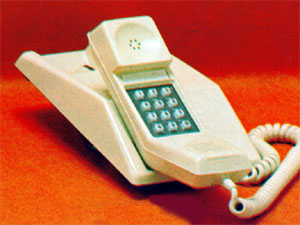
The Contempra was designed in-house by Northern Electric Limited to honour the 100th anniversary of the Canadian invention of the telephone. 
(Secretly recording) Dad: Good afternoon. This is Saturday afternoon at 3:45pm in Toronto, Ontario at (Greg’s Uncle) Fouad’s house. We have just come back from Brampton, Ontario, and we’re expecting a call from Mr. Pickett for Gregory to discuss the plans of the new Dadamore car. This is Holy Saturday, March 29, 1975, in Toronto Canada. 

Now we’re standing by for the call from Mr. Pickett, President of American Motors in Brampton, Ontario, to discuss the plans for the Dadamore car with Gregory. 
Greg: Greg Khouri. 
Bill Pickett: William S. Pickett Hello ?Hello, Mr. Khouri ?
No ... No, this is his son, Gregory. 
Bill Pickett: Oh hello, Mr. Khouri. This is Mr. Pickett from American Motors. 
Greg: Yes. 
Bill Pickett: I got from my people the plans that you delivered down to our plant. You have some pretty interesting ideas there. 
Greg: Yes.
Bill Pickett: Listen, I have to go down to Detroit for a meeting with my people on Wednesday of next week. Could you be available? 
Greg: I’ll try. 
Bill Pickett: You’ll try, eh? Well, we’ll be meeting at American Motors at 10 o’clock on Wednesday next, eh? 
Greg: OK. 
Bill Pickett: Now listen, the one thing that I’m a little concerned about is the air-condition system that you show on that car. Looks to me as though it’s going to be a little expensive. 
Greg: I know ... anyway I tried to make it fancy, so most people could buy it.
Bill Pickett: I see. Ah, well, you know at American Motors, we rely on putting out a product that not only is utilitarian, but not too so expensive, you see? 
Greg: Yes. 
Bill Pickett: And if we get into a pretty fancy arrangement like the air-conditioning plan I see in your car—well—I don’t know if we’ll be able to put it at a price the public could afford. 

Image result for canada one thousand dollar bill

Greg: Oh, I think I’ll make the price around four thousand. 
Bill Pickett: Around four thousand? That sounds pretty good. But, you see, what we have to do with a new model like this, and it’s something we have to look at very carefully, we have lot of plant and equipment to buy and the tooling costs a lot of money. Now, what do you think we’ll have to spend in terms of tooling up this new car? 
Greg: Oh, around ... let’s see ... maybe around five thousand dollars.
Bill Pickett: Around five thousand dollars? That doesn’t sound too bad. Ah, I’ll discuss it with my colleagues and hopefully you can down to Detroit on Wednesday, eh? 
Greg: OK. I’ll try. 
Bill Pickett: Fine. Now at the same time perhaps you can give my accounting people some idea of what you want to charge for the plans, because this is a pretty interesting proposition. 
Greg: OK. 
(At this point, Greg left Mr. Pickett hanging for nearly 45 seconds because he did not understand what he meant by ‘charges’.  It never occurred to him that he could be paid for his labour of love. Mr. Pickett must have thought he was dealing with an extremely hardball negotiator.) 
Bill Pickett: Hello ? Greg: Hello ?  Have you decided on what kind of changes you’re going to make for the plans? 
Greg: Ah, yes .... 
Bill Pickett: So what kind of figure have you in mind, a ball-park figure, so I can discuss with our financial people. 
Greg: Let’s see now ... look, I’m going to try to make ... Did you get, ah, the ten cylinders?
Bill Pickett: Ah, well, we may have to cut down on the cylinders a little. Ah, I don’t know if we can make it ten;we might be able to go down to nine. 
Greg: Did you understand what I meant by the brakes? 
Bill Pickett: Uh-huh. Yah. Yah. Ah, well I’d have to talk with my technical people too. They’re pretty excited about this. But, as I say, we can kick this around when we get down to Detroit. Greg: OK.
Bill Pickett: Alright?
Greg: OK.
Bill Pickett: Okay, fine. I look forward to seeing you in Detroit on Wednesday, eh? Greg: OK.
Bill Pickett: Good.
Greg: Bye.
Bill Pickett: Thank you. Bye-bye.
Greg: Bye. 

The price discussed in regards to Greg’s sketch of the Dadamore was $4,000 but more than forty years later, the memories of his conversation with William S. Picket are priceless. 


Visit my old car website at: The Oilspot Eh!
Copyright James C. Mays 2017 All rights reserved.

Sunday, May 13, 2012

1964 Rambler


  1. Trim differed greatly on the posh 1964 Rambler Ambassador, though it shared the same body shell with lesser Classic. The big difference was that Ambassador featured a V-8 engine.
    Riding high from being 1963’s Car of the Year and selling out to the walls with banner sales, Rambler entered the 1964 selling season with an attractive line of vehicles. All cars were now built domestically; virtually none were imported from the States.
In presenting the new line, President Earl K. Brownridge said, “We have built our success on this foundation and will never waiver from the dedication to base our product concept directly and specifically on true Canadian consumer needs.” He cited benefits to consumers, providing better value, an emphasis on quality and belief in compact cars as Rambler’s key to success in the Canadian market place. 


The compact and perky American had been redesigned from the ground up. Riding on a new, longer 2 962-millimetre (106-inch) wheelbase, it was beautiful with its deeply tunneled headlights and graceful lines. Only the 220 and the 330 series were offered in Canada, with the sole exception of the Rambler American 440 convertible, of which 936 were built in Brampton for the domestic market. A dozen right-hand drive convertibles, were exported. A total of 129 right-hand drive Rambler Americans were built. Records show that 19 left-hand drive models were also exported. 


The staff at Track & Traffic tested a two-door Rambler American sedan. They liked the style, noted the curved side glass, unusual in an economy car. “It is part of the smart new look for ’64, a trend-setter among compact cars.” The editor wrote, “Rambler has taken a great step forward with the American,” then boldly predicted, “in spite of its south-of-the-border name, there’s a big place for it in Canada.”


The most popular Rambler American model with the Canadian buying public was the 330 four-door sedan. It accounted for one out of every four Americans sold, reaching 2,890 units. The second most popular American was the stripped 220 four-door sedan. Workers produced 2,890 units, taking 22.5 percent of the model’s sales. Billed as Canada’s Economy King, a total of 11,731 Rambler Americans was produced in Brampton for the domestic market during the 1964 model year that ran from August 12, 1963 to July 16, 1964.

In Canada, the 1964 Rambler American convertible was the only model in the series offered in 440 trim.
Engine choices for the American were the venerable 3.2-litre (196-cubic inch), 90-horsepower, six-cylinder; the new, 125-horsepower overhead-valve six or the 138-horsepower, overhead-valve six. All were mated to a three-speed, manual transmission, though the self-shifting Flash-O-Matic transmission was an extra-cost option.
The Rambler Classic was very popular in 1964. The 550 four-door sedans were the second most sought after of the Classics by Canadians. A total of 3,214 were built in Brampton, Ontario during the model year run.
Next up the corporate ladder was Rambler’s Classic. Touted as “having a new low silhouette that looks so smart nestled in your driveway,” it was the company’s bread-and-butter line; Classic production reached 18,993 units during the year. The vehicles were offered in three trim levels: 550, 660 and the upscale 770. It is interesting to note that the 770 two-door sedans, available in the US were not offered here. 


Consumers liked the 660 four-door sedans best of all; 6,766 of them were built. The modestly trimmed 550 four-door sedans were second, finding 3,214 owners. The least popular Classics were the 770 station wagons, of which only 634 were built. Classic accounted for a whopping 58.3 percent of model year production. Of that final tally, 255 right-hand drive models were built.


Introduced in 1964, the ultra-modern, seven-main bearing Typhoon engine was the basis for Rambler's trio of six-cylinder offerings.
Owners could choose among three power plants for Classic: the standard mill was the 127-horsepower, overhead-valve six, the 138-horsepower version or the 198-horsepower V-8. The three-speed manual transmission was standard equipment but the extra-cost overdrive option was available on Classics as well as the Flash-O-Matic transmission.

Classic interiors were finished in a tasteful combination of vinyl and cloth. The seats were coil spring for a more comfortable ride. All Classics and Ambassadors carried a Cushioned-Acoustical Ceiling made of moulded fibreglass, guaranteed to cut road noise by 30 percent.


The 1964 Rambler Ambassador 990-H.
The finest Rambler money could buy was the Ambassador line. It was designed for Canadians who had a “yen for motoring at its luxurious best.” Although it shared its body shell with the Classic, trim and standard equipment set it a country kilometre apart from its Classic kin. The most important distinction was that the compact luxury flagship was available only with a V-8 engine.

While folks south of the border could choose between the 880 or 990 trim levels for their Ambassadors, only the more posh 990 trim level was offered to Canadians. The ultra-swanky 990-H hardtop was imported. The four-door sedan reached 938 units, the two-door hardtop 626 units and the four-door station wagon only 313 units. The Ambassador 990 two-door sedan seen Stateside was not offered here. Production for the most expensive Ramblers totalled 1,877 units, accounting for 5.8 percent of domestic Rambler production. A total of 60 Ambassadors were exported, all to left-hand drive countries. 

Visit my old car website at: The Oilspot Eh!
 
Ambassadors were powered either by the 250-horsepower or the four-barrel, 270-horsepower V-8 engine. The beefier mill required premium fuel. Like Classic, the engine was mated to a standard three-speed manual transmission, though overdrive and Flash-O-Matic were optional equipment.


Interior of the 1964 Rambler Ambassador was elegant. Here one sees the centre console and the rear centre armrest.
Ambassador interiors carried wood-grain inserts on the instrument panel and the doors. Upholstery was “a rich vinyl” or vinyl and cloth combinations in High-Fashion Colours: blue, green red, gold, maroon or turquoise. All interiors co-ordinated with matching cut-pile carpeting. An added touch of class was chromed bows for the Acoustical Ceiling.

After being dipped in anti-corrosion rustproofing bath right up to the roofline in giant tanks, Ramblers were given tough, triple-coat paint jobs. There were fourteen solid colours to choose from: Classic Black, Rampart Red, Forum blue, Westminster Green Aurora Turquoise, Bengal Ivory and Frost White. Then there were the metallic colours: Scepter Silver, Sentry Blue, Woodside Green, Lancelot Turquoise, Emperor Gold, Contessa Rose and Vintage Maroon. For $24.20 extra there were forty-two, count ‘em folks-forty-two two-tone combinations waiting to be had. 

Only 313 Rambler Ambassador 990 Cross Country station wagons were built in 1964. The tailgate opened like a door.
The optional equipment list for this year’s Ramblers was almost as big as Eaton's Catalogue. Those add-ons included power steering, power brakes, and power lift windows. The Flash-O-Matic transmission cost $209.30. There were headrests, Twin-Grip differential, Sunshade Solex Glass, backup lights and a push button all-transistor radio. The windshield washer cost $11.85, outside rear view mirrors sold for $6.50 each. There were seat belts, heavy-duty springs and shock absorbers. The fabled Weather-Eye heater added $83.75 and an engine block heater another $7.55 to the purchase price. White sidewall tires added $19.90 to the tab and full wheel covers replaced dog dish hubcaps for $18.20.


Rambler accessories filled a book in 1964.
One could order bucket seats-with or without console or centre armrest. Of course, there were split bench seats, too. For an additional $31.95 on models so not equipped, either buckets or split bench seats could be made into the famed Airliner beds with the flick of a lever. Wedge-cushions smoothed out bed contours, air mattresses made nap time comfy and insect window screens kept out bugs on an overnight sleep in one’s roadside Rambler Hilton.

Those were the glory days at Rambler Canada. On March 24, a milestone was reached when the 3,000,000th Rambler was built in North America. It happened to be an Ambassador 990 wagon and it happened to roll off the line in Brampton, Ontario.

Rambler was the fifth best selling car in Canada in 1964, with calendar year sales of 31,802 units. Pontiac took first place, full-sized Chevrolet took the number two spot (GM listed Corvair, Chevy II and Chevelle as separate makes), Ford was third (Fairlane and Falcon were listed as separate makes), and Valiant earned the fourth spot. 


Visit my old car website at: The Oilspot Eh!

Copyright James C. Mays 2004
All rights reserved.

Monday, April 30, 2012

1956 Nash

  Imported from the United States, the 1956 Nash Ambassador Country Club hardtop cost $4,220 f.o.b. Toronto, making it the most expensive Nash Canadians could buy.
Top brass at Nash Motors of Canada, Limited had a great deal to worry about as the 1956 sales season opened. Production in the Toronto factory and sales nationwide had been dismal in 1955. Although American Motors had been officially chartered in the United States since May of 1954, the corporate marriage had not yet taken effect in Canada. In 1954 Hudson's production facilities in Tilbury, Ontario had been closed and moved to Danforth Avenue in Toronto where it shared assembly lines with Nash-- the two grand marques were still operating as separate corporate entities pending legal hurdles that would allow them to amalgamate. 

The bright, shining star at American Motors Canada, Limited was the compact Rambler. The least expensive model in 1956 was the Deluxe sedan, selling for $2,447.

While the compact Nash Rambler was larger and new from the ground up, the senior Nash lines were on the second year of their styling cycle. The envelope was freshened up. Stylists referred to this as “perfuming the pig.” Headlights were still inboard but the fender-mounted parking lights and turn signals were now circular, set in a huge, ersatz air intakes. 


Brightwork was tastefully rearranged on the sides for a new look, dubbed Speedline Styling. The design lent it self nicely to two- and three-tone paint jobs. At the rear, enormous oval tail lamps were ensconced in a chrome pod that ran to the base of the fender and also housed elongated backup lights. These lights were particularly distinctive when set off with the Continental Rear Tire Mount.
The 1956 Nash Ambassador Super four-door sedan sold for $3,350 f.o.b. and weighed 1 612.5 kilos (3,555 pounds).
Posh Nash Ambassadors were imported from AM’s factory in Kenosha, Wisconsin, as were the Statesman hardtops. Statesman Deluxe Sedans were what rolled out the factory doors when production got under way in November of 1955 at the Toronto plant. Whether sourced from Toronto or Kenosha, the entire senior Nash cars were billed as the “Finest Travel Cars of our Time.”

For a few extra dollars, power for one’s Nash Ambassador was supplied by the Jetfire V-8 with its horsepower rating of 220. The engine was sourced from Packard.
The blazing 220-horsepower Jetfire V-8 powered the package. Advertising wasn’t shy to boast, “There’s silence so hushed the tick of the clock seems loud. There’s just one smooth surge of furious acceleration from the first touch of the throttle” and “Feel the lightening lunge of its getaway as it plasters you against the back seat.” 

The Statesman’s base power plant was the Nash-designed overhead-valve, tweaked to 130-horsepower in 1956.
Of course, the 135-horsepower Super Jetfire 6 was available as was the legendary 145-horsepower Le Mans Dual Jetfire mill that had set a record at the Grand Prix in Le Mans, France. Electrics were supplied by a new 12-volt system that provided significantly higher generator output, designed to meet the demands of lights, radio and air conditioning.

While a three-speed synchromesh manual transmission was standard equipment, the Twin Ultramatic self-shifter was an extra-cost option. Advertising called it the finest of all the automatic transmissions on the market. “You get split-second action—from standstill to 60 in seconds.” 

Instrument panel of the 1956 Nash Rambler was stylish and practical.
The vast cabin of the Ambassador could be appointed with special leather trim covering front- and rear-foam covered seats. The Statesman was given foam only in the front seat and the interior was dressed in a more sober two-tone cloth and vinyl upholstery treatment. Both Ambassador and Statesman carried a vinyl covered rubber crash pad atop the instrument panel.

The four-door hardtop station wagon Nash Rambler was an industry first.
The Nash Rambler was as striking as it was new. Like the senior members of the family, it boasted superior unit-body construction. Its headlights were inboard, at the ends of the Sports-Racer grille. It rode on a 2 743-millimetre (108-inch) wheelbase, making it considerably more compact than the Statesman. Styling touches included a highly attractive ‘basket handle’ sweep up the body, over the roofline. The headlines fairly shouted that the Nash Rambler was “Canada’s most miles-a-gallon car” and predicted that from Newfoundland to British Columbia, Canadians would “make the smart switch for ’56!”

Visit my old car website at: The Oilspot Eh!
 
Only the Nash Rambler Deluxe sedan was built in Toronto. The sedan, the four-door hardtop and the Cross-Country station wagon in the Rambler Custom family were imported from the United States. There were no two-door models among the 1956 Nash Rambler offerings.

The 1956 Nash Rambler Custom four-door sedan.
President Richard T. Purdy talked to the press about this year’s larger compact. “The Rambler was designed to meet the special needs and tastes of the Canadian market. We have turned out a car that is bigger on the inside and smaller on the outside—we believe there is a substantial group of the buying public interested in this compact car and these are the buyers we are out to win.”

The sole convertible Nash in 1956 was the Metropolitan. Imported from the UK, it topped the scales at  809 kilos (1,785 pounds).
Joining the Nash family for its third year was the miniscule Metropolitan from Britain. Manufactured to Nash specifications by Austin in Longbridge, England, the jaunty ragtop sold for $1,681 and the sophisticated little hardtop listed for $1,652. 


Both Mets wore bright cheery colours, rode on a 2 159-millimetre (85-inch) wheelbase and zipped down the road courtesy of a four-cylinder, 42-horsepower Austin engine. The first generation Met gave way to an updated 1500 model in April 1956. The new Met wore striking two-tone dress and boasted a tweaked 52-horsepower mill. Canadians snapped up 1,423 of the tiny Metropolitans during the calendar year.

Visit my old car website at: The Oilspot Eh!
 
Owners could hang almost as much optional equipment on their cars as Monarch butterflies could flock to Pelee Island. With the exception of the Metropolitan, one could make one’s Nash more natty with power steering power brakes, Power-Lift Windows, the fabled Weather-Eye Heating and Ventilating System or the breakthrough All-Season Air Conditioning.

Optional Airliner Reclining Seats and Twin Travel Beds that turned every 1956 Nash and Hudson into a roadside Hilton.
 Airliner Reclining Seats and Twin Travel Beds, the Twin-Ultramatic Drive or Dual-Range Hydramatic transmissions, Automatic Overdrive, an oil filter, an oil bath air cleaner, an electric clock, the Continental Spare Tire, the Twin Speaker Duo-Coustic Radio, white sidewall tubeless tires, 6-ply tires, Solex glass, seat belts, the hood ornament and Back-O-Matic lights, to name but a few.

Selling for $3,218, the Nash Statesman Deluxe was built by workers in Toronto. Records show that 639 were built during the 1956 model year.
The legal incorporation of American Motors Canada, Limited finally came into effect in January of 1956. An intense drive was promptly undertaken to beef up the dealer body. By the end of the model year, the number of dealerships Canada-wide had increased by nearly 50 percent.

Those officials who had worried so much at the start of the season now had plenty to crow about at its end. Sales were up by 116 percent for Rambler alone and total Nash and Hudson production had reached 3.68 percent of the domestic industry total—a huge increase from a paltry .85 percent the previous year. A total of 5,585 units were built in Toronto, a record. When they popped open the bubbly, no one in the head office had the slightest idea that 1957 would be the last year for the respected Nash name or that the company’s fortunes were about to soar as high into the stratosphere as the Avro Arrow.

From 1917 to 1957 Nash represented the best of independent automotive engineering and styling.

Visit my old car website at: The Oilspot Eh!

Copyright James C. Mays 2005
All rights reserved.

Monday, March 26, 2012

1961 Rambler

For 1961, Ambassador by Rambler was American Motors' flagship. The luxurious four-door Custom was imported from the US and sold for $3,388, taxes included.

Rambler might have been a new brand of automobile when it bowed to the public for the 1958 selling season but its heritage was drawn directly from the grand Nash and Hudson marques. Both of these automotive legends were highly prized by consumers for their upscale image and the ritzy, compact Rambler clipped right along that same glorious road. It represented value and economy to Canadians because it was priced right, sized right and carried all of the elegance and class of its predecessors.

Homegrown in 1961, the Rambler Classic 6 Super four-door sedan sold for $2,833 and the Classic 8 Super four-door sedan cost $2,995, fob Brampton, Ontario.
Consumers were delighted with the compact Ramblers but frustration reigned in the head office in Toronto. Just as sales began to explode throughout the Dominion, American Motors Canada, Limited had been obliged to close its Toronto assembly facility as a cost-cutting measure in the young corporation’s dark days of 1957. Studies showed that an assembly operation could be profitable if 10,000 units were built. As sales grew nearer and nearer to that point, the company was eager to get back into the game.


With great fanfare, officials launched its new, ultra-modern factory in Brampton on January 26, 1961. The doors were thrown open for a three-day gala and the nation was invited. Rambler’s return to the domestic automobile manufacturing scene was national news, generating excitement right across the country. Truth be told, the first car, a light blue four-door sedan, had been completed on Christmas Eve of 1960 but operations got underway in earnest in the New Year.

The smallest offering from American Motors in 1961 was the Metropolitan. Imported from the UK, the hardtop sold for $1,885. The 2 159-millimetre (85-inch) wheelbased cutie weighed in at  836 kilos (1,843 pounds).
The British-built Metropolitan kicked things off for the nation’s 321 Rambler dealers. Though it never carried the Rambler name, the captive import, built by Austin, was exclusive to American Motors on this continent and was offered as a two-door hardtop at $1,885 and a convertible with a list price of $1,925. 


These Mets were reserialed 1960 models because manufacture had been discontinued in 1960. The phenomenal rise of the Pound Sterling meant that the little car had lost its punch as an import fighter. Cuteness alone was its strong point, now. There had been no mechanical changes to the Met since it had been revamped for the 1959 selling season. Only the price tag had changed. Consumers were still charmed and 533 of them fell in love with the Met enough to purchase the tiny, adorable imports during the calendar year. Despite the low numbers, the Metropolitan still sold better than the Imperial, Ford’s Taunus and West Germany's diminutive DKW.
VW would have been the perfect addition to American Motors. A 1960 Beetle is seen here.

American Motors’ farsighted president, George Romney, had gone to Britain in 1957 and offered to purchase Austin but was politely rebuffed. Looking at prototypes of Austin’s 850 sedan, a.k.a. the Mini, with its $1,377 price tag, he knew small was the right trend. When The Austin arrived in 1959 it was the least expensive new car on the market. With sales of 4,034 of the micro-cars to Canadians, Romney could but wish that he had been successful in enticing the Longbridge concern into the AM family.

The 1959 Mini was a smashing success for Austin.
Romney had then travelled on to West Germany and offered to merge American Motors with Volkswagen but no one in Wolfsburg was interested in his offer. Volkswagen’s humble Beetle listed for $1,645 in Custom trim and $1,875 for the DeLuxe upgrade. With 29,754 sales, VW was the third best-selling car on the domestic market after the full-sized Chevs and the full-sized Pontiacs. 

The 2 540-millimetre (100-inch) wheelbased Rambler American was heavily facelifted for 1961. The Custom four-door sedan sold for $2,764 and weighed in at 1 169 kilos (2,578 pounds).
Necessity being the mother of invention, frugal American Motors took on the competition by dusting off the dies of the 1955 Nash Rambler and having designers freshen it up. Introduced as the Rambler American as a mid-year offering in 1958, the modestly appointed stripper was a huge hit.


Heavily reskinned for 1961, the highly stylish Rambler American was comprised of thirteen models spread over the Deluxe, Super and Custom Series. The company was justifiably proud in inviting the public to “meet the new American beauty.” In tackling the imports, American offered “the shortest and most maneuverable of any (Canadian) car” and reminded prospective owners that with American they got “50 percent more luggage space; high, wide doors for easy entrance and exit.” 

Mobilgas began sponsoring its annual Economy Run in 1936.

It didn’t hurt any that Rambler Americans won the Mobil Gas Economy Run year after year, either. Prices ranged from $2,334 to $3,001 for the ragtop, pitting the series squarely against the Chevrolet Corvair, Ford’s Falcon, the Mercury Comet, Chrysler Corporation’s Valiant and Studebaker’s Lark. 

Ragtops in the 1961 AM family were limited to Metropolitans and Americans. Tipping the scales at 1 239 kilos (2,732 pounds), the Rambler American Custom convertible listed for $3,001.
Only Classics were built domestically that first year but there were a lot of them; workers turned out 4,168 units of the fourteen (!) different six and eight-cylinder versions of the highly popular compact series for the 1961 model year. Advertising promised that the 1961 offerings were “a still more beautiful version of the car that gives the best of both: big car room and compact car economy.” Classics started at $2,681 for the DeLuxe four-door sedan in six-cylinder form and topped the chart at $3,718 for the Classic 8 Custom four-door, nine-passenger station wagon.

Four Cross-Country station wagons graced the Ambassador series in 1961. The Custom four-door (left) had a list price of $3,771 and the Super (right) carried a price tag of $3,204. Nine-passenger versions were available, as well.
Not quite a full-sized car and certainly not a compact, Ambassadors were a breed unto themselves on their 2 971.8-millimetre (117-inch) wheelbases and their 327-cubic inch V-8 mills. No two-door Ambassadors were offered in 1961. The elegant flagship with the European styling was available here in five models in either the Super or more sumptuous Custom series. Advertising predicted that Rambler’s “original compact luxury car will be the most imitated of 1961.”


Compact did not mean cheap at Rambler. The least expensive Ambassador was the Super four-door sedan listing for $3,204 while the absolutely posh Custom four-door hardtop, nine-passenger station wagon listed for $3,927—more than any Chev, Plymouth, Dodge, Ford, Meteor or Mercury on the market.

Every Rambler rolled out of the factory doors with Unit Construction, Deep-Dip Rustproofing, a Ceramic-Armoured Muffler and a Dual-Safe braking system. Classics and Ambassadors carried fireproof and waterproof Acoustical Moulded Fibre-Glass Headliners. 

The ultimate upholstery upgrade for the Rambler Classic cabin in 1961 was the Custom 400 interior with tasteful pleating on the split-bench, reclining seats. Headrests were another extra-cost option.
Popular options included the die-cast aluminum six-cylinder engine, the Flash-O-Matic transmission or overdrive, power steering, power brakes, Lock-O-Matic vacuum-powered door locks, Twin Travel Beds, Airliner Reclining Seats, a twin-grip differential, padding for the instrument panel and sun visors, a transistor-powered radio, power-lift windows, Solex glass, All-Season air conditioning and the unparalled Weather Eye heater and ventilation system.

With Arliner seats that folded flat, the Ramblulance was a life-saving vehicle in many small towns and villages across Canada, including Hudson, Quebec.

Cracking the Top Ten with 12,834 sales for the calendar year and 10,835 units for the model year, Rambler Canada celebrated a glorious 1961. It was but a harbinger of things to come; sales and production would more than double in 1962.

Rambler was perfect for rugged duty required of a taxi cab.
Visit my old car website at: The Oilspot Eh!

Copyright James C. Mays 2004
 All rights reserved.