Find Your Car

Showing posts with label Powerglide. Show all posts

Sunday, September 30, 2012

1957 Pontiac Laurentian, Pathfinder Deluxe and Pathfinder

The 1957 Pontiac Laurentian four-door hardtop and (right) two-door hardtop.
Canadians have loved Pontiac from its very beginning in 1926. The new brand from General Motors was tied to a First Nations theme, Pontiac having been a great warrior chief and brilliant war strategist in the 1700s.

Colonel Sam McLaughlin, president of General Motors of Canada, helped kick off the new car by being photographed in the rumble seat of a new Pontiac introduced at public festivities. In case anyone should miss the obvious connection, the Colonel wore a full native head dress.

The new 1926 Pontiac was billed as "Chief of the Sixes."

The new car was so much more popular than its Oakland companion that the latter was phased out of production at the end of the 1931 season.
Oakland was built from 1907 to 1931.
GM in Oshawa was quick to save money by having Chevrolet and Pontiac share chassis, engine and basic sheet metal. Automobile production was cut back after 1939, when Canada entered World War II and then suspended in 1942.

After the war ended in 1945, Pontiac was one of the first brands to roll off the lines in Oshawa. Now sold alongside Buick, dealers were grateful to have something to sell as Buick did not re-enter the domestic market until 1951.

Once Ottawa had balanced the nation's wartime budget, Buick was permitted to return to production.

In the mid-Fifties Pontiac suffered from the image of being a comfortable car for the more mature buyer and sales plummeted from third place in 1954 to sixth place in 1955. 

The 1956 Pontiac Laurentian was sold in the Union of South Africa as well as here at home.

Pontiac made a heroic comeback in 1956 to capture third place and would claim it again in 1957 with a record-breaking 48,140 units build during the calendar year. It would capture second place in 1958 and go on to beat out Chevrolet for first place several years later.


Semon (Bunkie) Knudson was determined to stop the disastrous slide when he took the helm of the Pontiac Division in the United States. He declared, "You can sell. a young car to old people but you cant sell an old car to young people." One of the first things he did was order the the twin silver streaks--a sacred Pontiac styling cue--ripped off the hood. He ordered Pontiacs onto the race circuit with terrific results. Canadians loved Pontiac and Knudsen would rekindle America's love affair with Pontiac, too.

The 1957 design was a reskin of the 1955 body shell. Ad copy called it 'Star Flight' styling. For Canadians this meant a Pontiac body shell reduced to fit on the smaller Chevrolet chassis. Regardless of the name in 1957, styling was loaded with aggressive, warlike looks. The front was more massive and laden more chrome than ever before. Bomb-shaped bumper guards flanked the vertically-fluted grille. Sides were graced with tasteful, full-length moulding that carried the lethal-looking missile theme. The sides contained a smart dip in the rear quarter panel to give the illusion of a fin at the rear. 

The backside of the Pontiac was in similar taste, resembling the rear of a jet fighter plane. A broad oval tail lamp protruded from a generous chrome housing set in a reverse--cant fender cutout. The oval was repeated in the bumper's dummy exhaust pot.

While American brochures liberally employed war and weapons terminology to describe styling, copywriters for Canadian line folders wrote a completely different story, bragging about the styling magic of Pontiac and extolling its clean-cut exteriors and graceful lines.
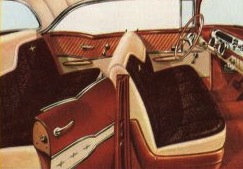
The casual elegance of Pontiac's interiors was referred to as "over the shoulder" styling.

With all the hoop-la around the design changes, Pontiac's mechanical side got plenty of attention, too. A new chassis gave Pontiac a lower centre of gravity and greatly improved roadability. Wheels got 35.5-centimetre (14-inch) diameters. Rear springs were widened to reduce lean when cornering. Front suspension was redesigned and Powerglide automatic transmission was introduced as an option.


Pontiac-Buick dealers offered Pontiacs in sixteen body types in three lines for 1957. The luxurious Laurentian, popular Pathfinder Deluxe and economical Pathfinder series were sharp to look at and fun to drive.

A full year ahead of our American cousins, Canadians could order fuel-injected power plants to stuff under the hood. Upon special order, GM would whip up a maximum performance package with competition-type camshaft, high-speed valve system and mechanical valve lifters for the 270 (4.4-litre) and 283 (4.6-litre) Power Chief engines.


Visit my old car website at: The Oilspot Eh!

Copyright James C. Mays 2001
 All rights reserved.

Tuesday, November 8, 2011

1963 Chevrolet Chevy II


Two convertibles were available in the Chevy II family in 1963. The 300 series ragtop carried a $2,896 price tag f.o.b. Oshawa when powered by the four-cylinder engine.
In the beginning, there was Corvair. It was because of the Chevrolet Corvair that there was a Chevy II. Chevrolet launched its Corvair compact with great fanfare in the fall of 1959 as a 1960 model. Featuring an air-cooled, rear-engine layout and enough interior space for six adult passengers, the Corvair was designed to compete head on with American Motors’ Rambler, not Volkswagen’s Beetle. Designers at Chevrolet were reminded regularly throughout its gestation period that it was the homegrown Rambler, not the imported Volkswagen, that was their target.
1960 Chevrolet Corvair was built in Oshawa, Ontario.

Corvair should have been a huge hit for General Motors. Oshawa’s sales and marketing departments watched with growing disappointment as its unique, rear-engined entry did not set the world on fire. GM Canada had invested heavily in a new facility for the compact. Workers in Oshawa built 7,237 units of the nifty little performers during the 1963 model year run but the restyled Rambler and the second generation Ford Falcon outsold the compact Chevy II by a country kilometre and more.
1963 Rambler Classic Cross Country station wagon.

The fact that Corvair didn’t sell particularly well was actually of some small relief to GM’s top brass in Detroit. When planning began for the Corvair back in 1956, it was widely feared within management that if Chevrolet successfully entered the compact market it might cause independent automakers Rambler and Studebaker to go bankrupt. That would undoubtedly prompt Congressional hearings in Washington. The resulting anti-trust action would surely lead to the break up the General Motors.

There was no need to fear. Even with the entrance of the Ford Falcon and the Valiant from Chrysler, the domestic desire for smaller cars grew stronger every day. Sales of Ramblers, Larks and West German Beetles continued to rise like the head on a good Molson Export. Since the independent automakers were more than holding their own, Chevrolet’s stylists and engineers were immediately put to work on a complimentary but more conventional “senior compact,” dubbed the Chevy II.


 The Nova 400 SS Coupe was a hardtop, weighing in at 2,590 pounds in 1963.

Chevy II production got under way at GM in Oshawa, Ontario for the domestic market. Nine models were available, three of them in the top-of-the-line Nova series. A Canada-only version of the Chevy II was badged as the Acadian brand and sold through Pontiac-Buick dealers.
1963 Acadian was a kissin' cousin of the Chevy II.

Bowing to the public for the 1962 selling season in September of 1961, the Chevy II was offered in four series: a base 100 equipped with a modest four banger and an equally stripped 200 model with a six-cylinder engine. Further up the ladder was a mid-priced 300 and finally, a very nicely appointed Nova 400. The 200 series was discontinued almost immediately after its introduction. When station wagons were counted in the mix, the model offerings swelled to a sweet sixteen in number.

Two brand new engines powered the Chevy II. When equipped with the thrifty, 153-cubic inch, L-head four-cylinder mill, rated at 90 horsepower, the price tag was $2,400. With the 194-cubic inch L-head six with 120 ponies ready to pull, the price tag rose to $2,470. Three-speed manual transmission was standard equipment but a new, lighter weight Powerglide automatic transmission could be ordered, if one wished to spend the bucks.


The plain Jane 1963 Chevrolet Chevy II 100 series four-door sedan cost $2,456 when equipped with the four-cylinder engine and $2,526 when the six-cylinder mill was ordered.
While Chevy II might be conventional in its powertrain layout, it was the first bowtie to make use of unit body construction. Going frameless put the little Chev on equal footing with the red hot Ramblers it was targeted to outsell. The 110-inch wheelbased cutie fit neatly between its smaller Corvair kin and the full-sized Chevrolets. Advertising billed Chevy II as “frisky” and “family sized.”


Designed for those who sought economy while raising a young family, a compact car cost less at the time of purchase. Financing required a hefty down payment and Ottawa kept credit tight. Parliament dictated that car loans must be paid off in a relatively short period of time.


The least expensive Chevy II in 1963 was the two-door sedan in the 100 Series. All of Chevrolet’s senior compacts rode on a 110-inch wheelbase.

Aside from a smaller outlay of cash at the time of purchase and lower monthly payments, it was estimated that an owner would spend $90 a year less in gasoline and cough up substantially less for insurance premiums. Those savings added up quickly. The practical Chevy II appealed to Canadians and it quickly soared in sales.

The folks at Canada Track & Traffic tested a Chevy II. Calling Chevrolet's new senior compact “an honourable compromise,” its editors were of the opinion that its styling was more European than American in its looks. Still, they passed it by and named Studebaker’s Lark as its Car of the Year for 1962.
1962 Studebaker Lark.

Production of the Chevy II in Oshawa added up to 15,802 units for the model year, which meant that the Chevy II captured 4 percent of the domestic market. In comparison, Ford Falcon’s total was 18,215 units beating the Chevy II and the now domestically-built Rambler’s 17,343 unit total by a whisker. GM’s cloned Acadian did nearly as well with 13,010 units produced.

Virtually unchanged for 1963, the Chevy II returned to Chevrolet-Oldsmobile dealerships across the Dominion. The six-cylinder, 300 sold for a modest $2,456, snapping hard at the heels of Rambler’s Classic 660 with its list price of $2,734. There were minor trim shuffles for the baby bowtie but more importantly, Chevy II was blessed with a better suspension. Important improvements were made to the unit body construction, as well.


Five of the ten Chevy II models offered in 1963 were station wagons. This is the top-of-the-line Nova 400.


 Consumers still wanted small cars but like last year, the phenomenon of loading compacts down with optional equipment was growing stronger. Powerglide transmission, radio, heater, bucket seats and seat belts were all popular extra-cost items.

A total of 19,993 Chevy IIs were sold during the 1963 calendar year, giving the senior compact 10th spot in sales. Acadian sales added 14,707 more. Valiant was the third best selling car in the country followed by fourth-place Volkswagen and Rambler parking neatly in fifth place.
1963 Volkswagen Beetle

More than forty years have passed since the Chevy II bowed to the public. John Diefenbaker’s Tories lost the federal election to Mike Pearson’s Grits in 1963. Jean Chretian was first elected to the House of Commons. The Bluenose II was launched. Simon Fraser University and  the Universite de Moncton were established. The Littlest Hobo, starring London, a German Shepard, debuted on CTV and The Forest Rangers bowed on the CBC. A cub reporter by the name of Peter Jennings reported President John Kennedy’s assassination from Dallas for the CTV Television Network. Gone but not forgotten, there was a time when life was simple and in 1963 part of that simplicity was the Chevy II.


Visit my old car website at: The Oilspot Eh!

Copyright James C. Mays 2004 
All rights reserved.

Tuesday, October 4, 2011

1950 Chevrolet in the US Market

It wasn’t Chevrolet's styling that caught Americans' attention in 1950; those graceful lines had been served up just the year before. Style changes were so modest that even a die-hard fan would have to look twice in order to distinguish the subtle differences between a 1949 and 1950 model,

Consumers were fearful that the Cold War was about to heat up. The USSR, China and the USA squared off over the future of Korea. Worried that the impending conflict would curtail auto manufacturing as it had in World War Two, buyers flooded dealers’ showrooms across the 48 states.

Chevrolet was given an all new model for 1950. More than 600,000 people had seen the 1949 Chevrolet Bel Air show car at GM’s Transportation Unlimited extravaganza in New York City and Detroit. Now Chev was given a dressed-up production hardtop of its own. Officially christened as the Bel Air Hard Top Sport Coupe, the prestigious and pricey pillarless two-door cost only $100 less than a top-of-the-line ragtop.

The hardtop convertible gave the feeling of riding in an open car without the inconvenience associated with a ragtop. The new body style was derived by welding the steel roof of a coupe onto a convertible’s body. The convertible body was used because it was heavily reinforced. That hard top, firmly positioned on the two-door convertible body, eliminated the “B” pillar located at the trailing edge of the front door and the leading edge of the rear side window on sedans.

There was more excitement as the long-awaited automatic transmission, Powerglide, made its debut. Chevrolet beat Ford and Plymouth to market by being first to install automatic transmission in car marketed in the low-priced fieldt. New owners were told that Powerglide was as easy as A-B-C. Instructions were to start the engine, set the “pilot control” lever and press on the gas! The two-speed self-shifter was of the torque converter variety. Automatic transmission added $159 to the price of one’s Chevrolet. Powerglide was available only on the higher-priced Deluxe models.

Most Chevrolets came equipped with the company’s familiar Stovebolt Six, tweaked to give 92 horsepower. Powerglide equipped cars were given a beefy 105-horsepower Chevy truck engine equipped with hydraulic lifters. The more powerful engine compensated for the slippage that was common in first generation automatic transmissions.


General Motors and the auto unions inked a deal, assuring labour peace for five years. Workers’ pensions began to be funded through the stock market. “Finer than ever for ’50” was the Chevy sales slogan and indeed, Chevrolet was America’s favourite car as sales topped the 1.5 million mark. With truck production added in, a new record was set as 2 million new bowties hit the nation’s highways in 1950.


Visit my old car website at: The Oilspot Eh!

Copyright James C. Mays 2005 All rights reserved.