Find Your Car

Showing posts with label Crown Victoria. Show all posts

Tuesday, May 17, 2011

1962 Vauxhall


            For more than a decade Vauxhall had been General Motors' captive import, sourced from the United Kingdom. Since it first arrived in our fair domain in 1948, Vauxhall had done very well for itself. Consumers had plenty of confidence in the sturdy and very economical little cars because they were backed by the vast resources of General Motors of Canada, Limited.

            For the 1962 selling season, Vauxhall fielded three models in the Dominion through Pontiac-Buick dealers. The upscale Cresta and its lower-priced stable mate, the Velox, covered the luxury and economy six-cylinder segments of the compact market. The smaller, four-cylinder Victor, offered in three trim series, did battle with other imports on behalf of GM Canada. All were of unitized construction, like Rambler.


Visit my old car website at: The Oilspot Eh!

            Cresta was Vauxhall’s flagship. This particular body shell had been first introduced in1958, making it five years old. Consumers were familiar with its look. Nonetheless, the original styling, inspired by Vauxhall designer David Jones, was classic and each year’s updates were attractive.

            The Cresta was “distinguished by an outstandingly generous array of extra refinements, extra luxury and extra equipment at an unusually modest price.” Its wheels were given polished aluminum trim rings to make the hubcaps look like full wheel covers. Whitewall tires were standard equipment on Canadian Crestas. Interestingly enough they were not available even as an option in Britain. Receiving brightwork in all the places a flagship should, the inclusion of arm rests, deep pile carpets with thick underlays, a wide, centre armrest for the rear seat, windshield washer, electric clock, a trunk light and a cigarette lighter in the base price all added up to one posh vehicle.

Visit my old car website at: The Oilspot Eh!

It was offered in no less than fifteen different solid body colours and another fifteen very striking two-tone colour paint jobs with high-lustre finishes. One could choose between nylon patterned cloth or genuine two-tone leather for the interiors. If one wished to shell out a few extra dollars, Cresta could be had with split-bench seats up front or a fold-down centre arm rest.

A Vauxhall Cresta four-door sedan started at $2,791. It fit very neatly into GM Canada’s overall compact lineup.  An Oldsmobile F-85 four-door sedan sold for $3,200; Chev’s new Chevy II sold for $2,470; the Corvair Monza four-door Coupe started at $2,701 and the compact Buick Special listed for $3,218. It was in the ballpark with non-GM competition, too: A Simca Vedette sold for $2,805; A Valiant 200 four-door sedan listed for $2,571 and a Studebaker Lark V-8 Regal for $2,685.
The 1962 Vauxhall Velox rode a 105-inch wheelbase and weighed in at 2,630 pounds.

Velox was positioned downwind of Cresta by more than $300. Blackwall tires, less trim and fewer standard features made it attractive as a six-cylinder value purchase for many. Velox was available in fourteen solid colours and interior fabric choices were either Vynide or the Tygan-Rayon cloth. Velox owners still got carpeting and a padded instrument panel finished in “a quality walnut-grain finish.” Split-bench seats or the centre armrest for front passengers were optional on Velox. Delivery price for a Velox was $2,468.

Visit my old car website at: The Oilspot Eh!


Both Cresta and Velox shared the 162 cubic-inch, 113-horsepower, six-cylinder engine. The engine had proven itself well since its 1952 introduction. It was capable of pushing the big Vauxhalls to 90 miles per hour, well above the posted speed limit anywhere in the Dominion.  A three-speed, manual synchromesh transmission was standard but GM’s Hydra-Matic was available for a price.

The Victor Estate Wagon bowed for 1962.
It was the heaviest Victor with a weight of 2,200 pounds.
Victor was considerably smaller, used a four-cylinder power plant and took the lion’s share of sales in Canada. It was all new for 1962. Victor was not alone, either. Chevrolet-Pontiac dealers sold a badged version called Envoy. Advertising claimed that the little car had “fresh, new aerodynamic styling.” The editor of Track & Traffic was more guarded with his words, calling the new look “sober and unadorned.” Victor was offered in De Luxe, Super and Standard trim.


The De Luxe Victor offered optional, extra cost, two-tone colour treatments outside and sported two-tone, leather upholstery on bucket seats as standard equipment inside the cabin. The De Luxe started at $2,156. Competition included the Hillman Super Minx, which sold for $2,195.

For the 1962 selling season, the 100-inch wheelbase Vauxhall Victor was all new.
The De Luxe sedan weighed in at 2,125 pounds
.


There was less trim and fewer goodies found on the Super. Rear passengers sank their feet on thick pile carpeting while front passengers had   to make do with durable rubber floor mats. Super owners still got a two-spoke steering wheel, two sun visors, a padded instrument panel and a full circle horn ring. There were thirteen two-tone colour combinations available on Super models. Bucket seats were optional equipment but were upholstered only in Vynide or Tygan-Rayon cloth. The opening price on the Vauxhall Victor in Super trim was $2,053.

At the bottom of the Victor barrel was the Standard. It came without chrome on the body and was devoid of extras. The solid colour choices were limited to Black, Alaska White, Smoke Grey, Mist Blue, Bermuda Blue, Midnight Blue, Alpine Green, Glade Green, Honey Gold and Primrose. A heater, specially designed for Canadian winters, was still among the items listed as standard equipment. It carried a three-spoke steering wheel with a modest horn button at its centre. There was no deep pile carpeting; rubber flooring was used throughout.

1962 Volkswagen
It appeared to be difficult to write much about the stripper though wordsmiths did manage this: “When you buy it-when you drive it-the new Victor Standard gives you the most for your car dollar.” The owner paid $1,947 for his purchase. As basic as it was, Victor still cost a good $600 more than a Volkswagen Beetle.

All of the new Victors used Vauxhall’s 92-cubic inch, four-cylinder engine. It was rated at 56.3 horsepower. While a three-speed, column mounted manual transmission was standard equipment, a new floor mounted, four-speed manual was offered this year at extra cost.

Options for Victors included a radio and aerial, windshield washers, fog lights, a cigarette lighter, seat covers, a spare wheel cover, exterior mirrors and plastic floor mats.

Vauxhall sold well enough in 1962. The new Victor racked up 7,386 sales for the calendar year and big brothers Cresta and Velox added 817 more sales to that figure. It was still the Number Two best-selling import in the country. Only Volkswagen sold more cars in the import category.  The 8,203-unit finish was surprisingly strong in light of the devaluation of the dollar by the Conservative government and new federal government surcharges on imported automobiles.


 Visit my old car website at: The Oilspot Eh!


Copyright James C. Mays 2005 All rights reserved.

Saturday, January 15, 2011

1955 Ford


 Absolutely everyone associated with Ford Canada was as happy as larks (not the Studebaker variety to come) with the great success with the company’s 1954 Golden Jubilee. As the celebrations wound down, the nation’s oldest automaker prepared to usher in the second half of the century with the 1955 product line. 

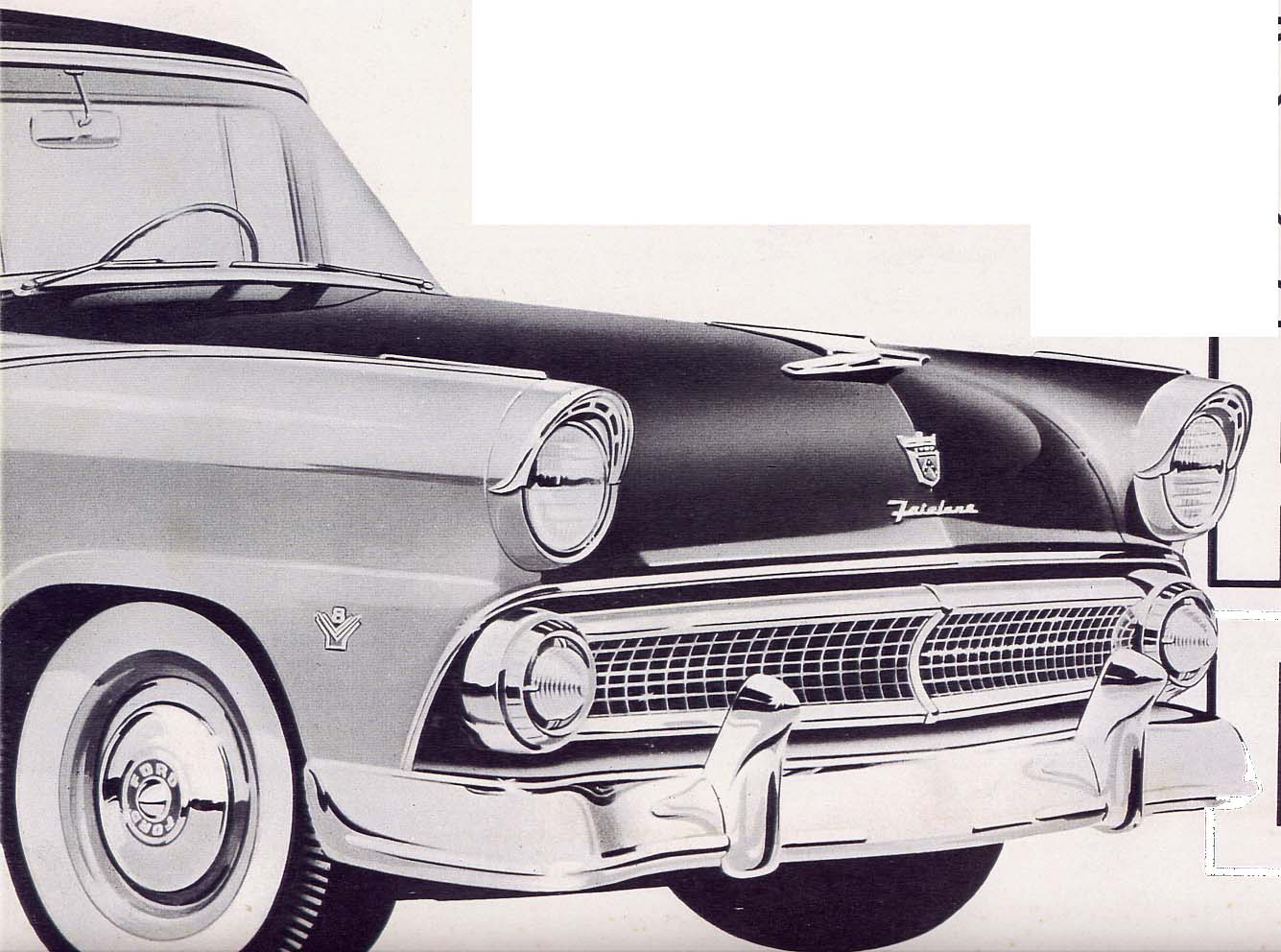
The 1955 Ford lineup was sharp looking. 
Cars rode on a 115-inch wheelbase.
Negotiations between labour and management had not been going well for some time but both sides agreed not to upset the festivities. The last of the 1954 models rolled out the doors on October 7.  


On October 10, 1954, the talks stalled out. The sticking point was a 30-cent an hour pay rise and retro pay of 35 cents an hour to the end of the last contract. With no new offers forthcoming, 5,200 workers in Windsor, Ontario laid down their tools and headed for the picket lines. Even employees at the power plant struck. Office workers were instructed to report to work at temporary outside quarters as the administration buildings grew cold from lack of heat. 


Visit my old car website:  www.theoilspoteh.ca

The strike spread to Oakville on October 15 when 1,500 union brethren laid down their tools in sympathy. The company responded by moving its national headquarters permanently to Toronto on the 21st. The strike deepened when the 125 employees at the Etobicoke-based national parts depot joined in. Christmas came and went. On December 29 management announced it was prepared to consider a province-wide agreement for all 8,603 union employees but talks were recessed until January 3. Negotiations were tough and the 110-day strike was settled on January 27, 1955. Employees could get back to work and consumers could have their Fords. Manufacture began in early February. 


The 1955 Ford Mainline was the second least expensive
 model in the family. It cost $1,908.
The 1955 Ford Town Sedans were highly popular with consumers.
The four-door version (shown) cost $2,139 and the two-door $2,091.


The 968 dealers throughout the Dominion were absolutely frantic. The new Fords were to be unveiled to the public on November 10 and the Monarch lines on the 22nd. With a strike in progress and no 1955 models built it was hard to work up any enthusiasm for orders. A handful of models, not built in Oakville, were imported from the US so potential consumers would have something to see. Those cars included the four-door, three-seat Country Squire and Country Station Wagons, the Thunderbird and the Fairlane Crown Victoria with the transparent top. 

Visit my old car website:  www.theoilspoteh.ca

British Fords arrived at the port of Montreal for shipment to dealers. Zephyr four-door sedans and convertibles were prepped for public scrutiny along with Zodiac sedans and Consul ragtops. 

The Sunliner  (above) cost $2,451 in 1955. The imported  Ford
Zephyr convertible was evemmore expensive with its
$2,505 price tag.
When the new domestically built Fords did arrive at dealerships they were beautiful and well worth waiting for. Showroom floors glittered with six Fairlane models, two Customlines, a pair of Mainline models, a quartet of station wagons and the sensational Corvette-eating two-seat Thunderbird. 


The modest Mainline series consisted of a business coupe, a two- and four-door sedan. Sober and unadorned transportation they might be but advertising was able to truthfully bill them as “smartly practical new body styles” and “comfort you might expect only in cars costing hundreds more.”  Much was made of the fact that the doors were nearly a yard (ancient Canadian units of measure) wide and stayed open with a two-stage door check. 

The 1955 Ford Crown Victoria with the transparent top
weighed in at 3,388 pounds and cost $2,730.

The glamour queens in the Ford line belonged to the Fairlane family. There were a half dozen of the beauties to choose among. Catching up to independents Nash and Studebaker, Ford finally fielded a true hardtop model. The two-door Victoria was “enhanced by the new wrap-around windshield” and “quarter windows roll down out of sight leaving no centre posts and providing a wonderful feeling of openness!”

Visit my old car website:  www.theoilspoteh.ca
The Customline series was limited to a two- and four-door sedan with price tags of $1,957 and $2,006 respectively. Like the Mainline, it had black rubber flooring but the Customline received two sun visors, a half-circle horn ring and twin horns, foam in the seats, arm rests front and rear, an ash tray for back seat passengers, a cigarette lighter, a stem-wind clock, assist straps on the Tudor, coat hooks brightwork around the windows and exterior mouldings.


Crown Victoria interiors were replete with a centre arm rest.
The Crown Victoria with its massive “crown of chrome” at the B pillar could be had with the transparent “skylighted top.” Despite the glitzy centre post, advertising bragged that the Crown Victoria was “the style-setter of the hardtops.”  Less exotic Fairlanes included the lovely Sunliner convertible, the luxurious four-door Town Sedan and its equally posh stable mate, the two-door Club Sedan. 

Fairlane cabins were appointed with carpeting throughout. Upholstery was Nylon and Vinahyde or two-tone Vinahide over foam rubber cushioned seating and the steering wheel and steering column were colour blended to match the sumptuous surroundings. A unique space-age feature was the Astra-Dial speedometer with its clear plastic bubble top.

The eight-passenger Ford Country Squire
was imported from the US. Its hefty
$2,869 price tag was surpassed only by that of
the new Thunderbird.
Then there were the station wagons. The simple Ranch Wagon was a steal at $2,239 though customers looking strictly at the bottom line would opt for the Nash and Hudson Rambler two-door wagons, the least expensive on the domestic market at $2,127. Ford’s Custom Ranch Wagon could be ordered with two-tone finish, brightwork trim and “extra-colourful interiors.”  The third seat in the Country Sedan offered “room for eight or freight.”  The swanky Country Squire not only carried eight passengers, it stood apart as “ a station wagon of high distinction” with its Mahogany-grain-finished panels framed by a lighter coloured, wood-grained glass fibre mouldings gracing its sides. 


Finally there was the slippery Thunderbird, billed as the “brilliant personal car.”  The sleek and elegant two-seat sports car was as breathtaking as its $3,655 price tag. 

No matter which of the fifteen Fords one bought, there was but one mill-the ultra modern Y-block V-8. The 272-cid monster was mated to a higher torque, three-speed standard transmission. The manual tranny could be ordered with Overdrive or one could opt for Fordomatic, the shiftless transmission that featured an illuminated Safety-Sequence Selector in the P-R-N-D-L pattern.

Ford offered “Canada’s most modern Power Assists” as optional equipment. Power Lift windows, Swift Sure Power Brakes, Master-Guide Power Steering and the Four-Way Power Seat. Other add-ons were dual exhaust (standard on wagons and Fairlanes), white sidewall tires, a positive-action windshield wiper unit, a heater, the Full Circle Radio, rear fender shields and full wheel covers. 

Despite the lengthy strike, workers in Oakville pumped out 55,262 Ford passenger cars for the 1955 model year. The company announced it would spend $8.6 million to build new headquarters in Toronto. 

Visit my website:  www.theoilspoteh.ca
Copywrite 2004 James C. Mays