Find Your Car

Showing posts with label Oakville. Show all posts

Saturday, October 7, 2017

1961 Comet

Comet was the newest brand of automobile for Canadians in 1961. The two-door sedan weighed in at 1 140 kilos (2,513 pounds).

Euphoric Mercury-Meteor dealers blasted into the 1961 model year with its third new brand in four years. The 1958 Edsel was history after three seasons, as was last year’s Canada-only Frontenac. New for 1961 was the Comet. 

1961 Rambler Ambassador 

Comet was neither a Mercury nor a Meteor. Rather, it was a stand-alone brand—in a new size. The 2 895-millimetre (114-inch) wheelbased entry burst into the automotive world. It was initially dubbed billed as “the better compact car”  and, “new, value-packed”. The only competition in that wheelbase niche was the luxurious Ambassador by Rambler, marketed in the far upscale Imperial, Cadillac and Lincoln-land territory. 

An early clay mockup of the Comet (top) carries the Edsel name on the front door and fender. Comet (bottom), as photographed from the rear, appears to be a functional prototype. 

Comet arrived with “a spirited sense of proportion” that “gave it the most successful styling in its field”. Oddly, it started out on the drawing board as an Edsel, under the watchful eye of head stylist Robert B. Jones.  First clay prototypes rendered in 1957, closely resembled the Edsel. However, the mid-priced marque proved unsuccessful. After three  short seasons, Edsel was sent to automotive heaven but the junior Edsel carried all the earmarks of a winner. Management gave the green light to the project and they were right on the money. 

The four-door Comet sedan’s wheelbase measured The 2 895-millimetres (114-inches) and was 4 948 millimetres (194.8 inches) in overall length. 

Advertising bragged that Comet—the only compact car with fine-car styling had burst over Canada—as a US proven success. The Comet brochure reported the last year, workers in the Lorain, Ohio plant had built more than  than 250,000 cars, travelling more than a billion miles (1.6 billion kilometres) on American highways. With “the the look of success, the size of success and the feel of success”, brochures  crowed that Canadians would prefer the Canadian-built Comet and workers in Oakville, Ontario set out to prove them right. 

Our new national highway will open officially in 1962. Stretching  7, 821 kilometres from St. John's to Victoria, it is one of the longest roads on Earth.
Whether the driver was headed across town or across the country, Comet made travelling ‘lighthearted fun”. Two feet  (609 millimetres) shorter than a full-sized car, steering was light and handling was effortless. The longer wheelbase translated into smoother ride. That was a good thing to remember, considering that large stretches of the brand new Trans-Canada Highway were still gravel-bedded road. 


Jones and his team of designers changed the grille at the last minute before introduction, so it more closely resembled Mercury and Meteor offerings. Nine stacks of vertical bars graced the face with dual headlamps at the ends of the gentle oval. Comet script appeared on the right side of the hood, split in the centre with a tasteful crease. Dual gunsight ornaments sat atop the front fenders, near the leading edges. They crowned a pair of equally tasteful body creases. A restrained bumper held parking/turn signals in the lower tier and wrapped around to kiss the heavily-browed, front wheelwell. Full wheel covers were split into three-spoked divisions, carrying a ripple of  rings to a plain, chromed and domed centre. 

The soft, “round-body” envelope was punctuated with a chrome-highlighted crease, just below the door handles, where it kicked up to the top of the rear quarter panel with a discrete but decided chrome-accented flounce. The body carried a wide, butter-knife indent. Comet script appears at the rear, boldly flashing the tasteful fin. At the leading edge of the front fender, a trio of hash tags let everyone know that this was no ordinary small car, Comet a classy ride. Stylists set the car apart further from the competition with the formal, The Thunderbird-look roof C-pillar carried a tasteful Comet insignia above a multiple-striped chrome strip at its base. 


The rear of the Comet was most distinctive with canted ovoid lamps that capped the fins. A crest sweetly kissed the trunk lid, above the centre-mounted gas cap. Comet was spelled out in capital letters on a elongated chrome-look  horizontally striped panel that curved gracefully downward at the edges, to top the bumper. 

Cargo space in the Comet station wagon was  2.1 cubic metres (76 cubic feet) in capacity. 

Surprisingly, station wagons were shorn of the fins. Comet wagons were given semi-circular, gunsight-look taillights housed in bright-metal mouldings. The rear wagon window rolled down, although an electric wind option was available. An extra-cost luggage rack, with  five-stripes of  aluminum  support roof shafts, were included in the option.  Scuff-proof rubber was chosen for the wagons’ flooring—easily cleaned with soap and water. The cargo area measured 2.1 cubic metres (76 cubic feet)—the same as Frontenac and Falcon.


When equipped with the base engine, Comet’s fuel consumption was: 13.8 litres per/100 kilometres (20.5  miles to the Imperial gallon). 
Under the hood, Comet shared its 2.4-litre (144-cubic inch}, six-cylinder engine with its Ford Falcon cousin. Taking a swipe at Chevrolet’s Corvair, advertising bragged that the whisper-quit Thrift-Power Six engine was “front-mounted for better weight distribution, safer driving on all roads.” New this year was the larger, 2.7-litre (170-cubic inch) Thrift-Power mill. Since the Comet weighed more than 200 kilos (400 pounds) more then the Falcon, the extra horsepower was more than welcome—at a cost—of course.

Visit my old car website at: The Oilspot Eh!

The three-speed conventional drive was “unusually smooth and responsive, with gearshift conveniently located on the steering column”. Optional Comet Drive automatic transmission gave owners “fully automatic driving at a budget price” because of its simplified design. 

The heavily insulated cabin held six people seated on foam-cushioned seats, fore and aft. Canadians were told they would “praise Comet’s big-car comfort and beautiful Interiors” that were “colour-harmonized” to compliment the Super-Enamel exterior paint offerings. Passengers would appreciate the extra stretch-out space afforded by the longer wheelbase and be better protected from injury in the strongly reinforced unit body that featured double ribs and strong crossmembers for greater strength and rigidity. 


Comet shared an instrument panel with its Ford Falcon kin.


The instrument panel was simplicity itself. A strip speedometer was housed in a large chrome oval with a pair of smaller chrome ovals at the extreme edges—one gauge for fuel, the other for engine temperature. The odometer was placed below the speedometer, flanked by oil and generator lights. Typical of Ford products, the ignition was located at the far left of the panel in the same row as the operations knobs. Comet script was placed in the centre of the panel, above the radio. A centre-mounted ash receiver was located below, in the same lower lip as control knobs. In front of the passenger was the glove compartment. It carried a chrome-look Comet-maple leaf chevron that stretched across the door.

Visit my old car website at: The Oilspot Eh!

Standard equipment included the Blue Oval’s Safety Steering Wheel, dual horns and tandem-action windshield wipers. Two front armrests, dual sun visors, an aluminized muffler, an automatic choke and an oil filter all added to the Comet’s value.

 Image result for artist's palette clipart

The artist’s palette was broad for Comet. Colours for Canadians were different than those built in the States. Paint was sourced from the famed Rinshed-Mason Company in Windsor, Ontario, a company that supplied not only the automotive industry, but clad NASA’s experimental X-15 fighter jets and the official dress of the Eiffel Tower. 


Image result for eiffel tower clipart

The colours offered to domestic Comet consumers were: Sultana White, Starlite Blue, Saffron Green, Signal Red, Sunburst Yellow, Empress Blue, Regency Turquoise, Columbia Blue, Green Frost and Sheffield Grey. Two-tone exteriors were available for a fee. 
Related image

Canadians could come home with their Comets in any of a quartet of body styles. The two-door sedan listed at $2,447  while the four-door sedan was priced at $2,513. The two-door station wagon was a bargain at $2,776 and Comet’s four-door, six-passenger workhorse rang in at a modest $2,848. All prices included Ottawa’s hidden 13.5-percent Manufacturer’s Tax. 

Image result for 1961 Meteor
 A pair of 1961 Meteor Montcalms

Management in Oakville reported both Frontenac and Comet production under the Meteor category, Extrapolated figures show Comet ranked Number Six in domestic calendar year sales in its Canadian marketplace debut, with 17,658 units built. Of that figure, records show that 3,718 Comets rolled out the Oakville’s doors during the 1960 calendar year. That gave Comet 5.6 percent of the market. Ford’s Falcon came in with a commanding 19,876 builds, accounting for 5.88 percent of the pie. Oakville was crowned King of the Compacts, with Rambler in second place with more than 11,000 cars built and sold.

Trunk space was “family-sized” generous in the 1961 Comet.

The Ford Motor Company of Canada, Limited celebrated more milestones that year. It spent $6 million on a new glass fabrication plant in St. Thomas, Ontario. Ford’s new corporate headquarters building, situated in Oakville, opened in April. Ford of Canada was on a roll and even better times were just around the rainbow’s bend.


Visit my old car website at: The Oilspot Eh!

Copyright James C. Mays 2017 All rights reserved.

Monday, September 26, 2011

1973 Ford Torino

The 1973 Ford Gran Torino Brougham was perfectly capable of hauling a good-sized trailer from St. John's to Victoria and lots of places in between. The four-door sedan carried a sticker price of $3,768 when fitted with the V-8 engine.
Torino was Ford’s intermediate offering in 1973. Since the average consumer was focused on smaller than full-size rides, Ford bragged that its Torino was the “mid-size that’s big on comfort, confidence and quiet.” Oakville’s 114-inch wheelbased intermediate (118 inches for four-door models) had been completely redesigned in 1972, so for the 1973 selling season there were refinements in the four series. The front grille was opened up substantially and—in anticipation of new safety regulations from the Ministry of Transport—a much larger and now impact-absorbing front bumper was fitted to the body.

 Carrying its own distinctive fastback roofline, the 1973 Ford Gran Torino SportsRoof boasted a list price of $3,776.


Except for the Sportroof model, all Torinos were powered by Ford’s 250-cubic inch six-cylinder engine, married to a three-speed manual transmission. The sassy Sportroof was a faster Ford, tearing up the asphalt courtesy of the 302-cubic inch V-8 mill, though it was still mated to a three-on-the-tree manual transmission.

If one wanted to get “there” in a hurry, extra-cost engine choices included the 351 two- or four-barrel V-8s, the 400-cubic inch two-barrel eight banger. In a category all by itself stood was the mighty 429 cubic-inch, two-barrel V-8.

The base Torino came as a no-frills two-door hardtop, a four-door pillared sedan and a wagon. “Where value speaks louder than words,” was the hue and cry wordsmiths chose to show off the stripper. While the car was as basic as tap water and the flooring of rubber, the interiors were finished in easy-care vinyl in Beige, Black, Medium Green and Medium Blue.
 The 1973 Ford Torino Squire carried faux woodgrain trim and listed for $4,197.
 The Gran Torino wagon was a bargain at $3,722 f.o.b. Oakville.

The Gran Torino featured the same three models found in the base series but added a dressy Squire station wagon to the model mix. The mid-priced, mid-sized Ford was “leading a quiet revolution.” Much was made of the quietness and of the extra “heft” in the car itself. “On the road, comfort is king with deep cushions and plenty of head, leg and shoulder room. Room enough, in fact, for six adults to sit comfortably.”

Gran Torino interiors could be had in luxurious pleated cloth and leather or a Sport Cloth in Ginger or Black. The Pleated Vinyl Seat trim was only available on the Squire wagon which was also blessed with the 302 V-8 as standard equipment.

The Gran Torino Broughams came as a posh pair—a hardtop and a four-door pillared sedan. These sirens of the highway promised that “splendour was the inside story” and whispered of “luxury and quality you might expect to find in high-price fine cars.” 

Interiors in the Broughams were finished in nylon cloth fabrics with “leather-like vinyl” seat trim and door panels. Colour choices were Tobacco, Beige, medium Blue, medium Green and Black. The Flight Bench seat boasted a fold-down front centre armrest.
Instrument panel of the 1973 Ford Gran Torino is seen here with the optional three-spoke Rim-Blow steering wheel.

The Brougham’s instrument panel carried “woodtone inserts” to highlight the instrument cluster, the glove box panel and the deluxe two-spoke steering wheel.

The Gran Torino Sport hit the asphalt as a two-door hardtop and a two-door Sportroof model. “Call it responsive, call it rakish, call it fun!” advertising bubbled unashamedly. These two came with the 302-V8 as standard equipment stuffed under the hood and a host of other unique niceties including a special ornament for the grille, F-70x14 raised white letter Wide Oval tires, special accents, wheel lip mouldings, dual racing mirrors and trim rings.

 Visit my old car website at: The Oilspot Eh!

Interiors for the Gran Torino Sport were thickly padded and pleated. The vinyl seats, with their low-profile head restraints, were designed to be supple and sporty. Colour choices were Black, Beige, Medium Blue and Ginger.

Diamond Lustre colours for the exterior were available in Black, Bright Red, Red Metallic, Fuchsia, Light Blue, Medium Blue Metallic, Bright Blue Metallic, Silver Blue Metallic, Bright Green Gold Metallic, Bright Lime, Medium Aqua, Medium Green Metallic, Dark Green Metallic, Light Green, Medium Ivy Bronze Metallic, Pewter Metallic, Ginger Metallic, Ginger Bronze Metallic, Tan, Medium Chestnut Metallic, Light Goldenrod, Yellow, Medium Bright Yellow, Bright Yellow Gold Metallic, Medium Gold Metallic and two—not one—shades of White. Metallic paints cost extra and there were optional Tutone paint jobs available for the Gran Torino Sport.

Visit my old car website at: The Oilspot Eh!

The list of optional equipment was as long as the Trans-Canada Highway. Goodies included trailer towing packages, a three-spoke Rim-Blow steering wheel, SelectShift Cruise-O-Matic Transmission, AM/FM stereo radio, SelectAire Conditioner and electric clock. There was an Appearance Protection group that included door edge guards; rubber floor mats and an anti-theft spare tire lock, electric power door locks, and colour-keyed dual racing mirrors. 

New for 1973 was a selection of steel-belted radial ply tires. One could order the electric rear window defroster, bodyside mouldings—to protect against dents and dings, power front disc brakes, numerous wheel covers or chrome wheels, a deluxe bumper group, six-way power seats, rear seat speakers, a tachometer, engine gauges, power steering, power tailgate window, a rear-facing third seat for wagons, interval wipers, power side windows, high back bucket seats with centre console, a leather wrapped steering wheel, vinyl roof tops, four-speed manual transmission with a Hurst Shifter, heavy duty battery, competition suspension and a Traction-Lok Differential.

Ford-Meteor dealers sold 30,804 new Torinos in calendar 1973. That made Oakville’s mid-sized car the sixth best selling nameplate in Canada, positioned neatly between Plymouth Valiant in the Number Five spot and Dodge Dart in seventh place.

  
Visit my old car website at: The Oilspot Eh!

Copyright James C. Mays 2007 All rights reserved.

Tuesday, January 25, 2011

1973 Ford Maverick


The 1973 Ford Maverick four-door sedan rode a wheelbase 
stretched  by 152 millimetres (six inches). With a six-cylinder engine the Maverick 
sold for $2,739 in Canada. 


North America’s compact car wars heated up considerably for the 1970 selling season as American Motors and Ford unleashed the next generation of domestically built small cars. Ford would replace the venerable Falcon in the North American market with its compact Maverick. The western-themed name was chosen to reflect on and hopefully cash in on the company's runaway success with Mustang


American Motors introduced the Hornet for the 1970 


selling season. Its target competition was Ford's new 
compact Maverick and a legion of imports.

American Motors dropped a cool $40 million for the Rambler's replacement--the car that started the compact craze in 1950. Even the Rambler name disappeared as the last of the independent automakers updated its stodgy image. Marketing dipped into the corporate name bin to borrow the Hornet name from the Hudson side of the AMC family as it launched its “little rich car”.


Visit my old car website at http://www.theoilspoteh.ca 


Ford's Maverick bowed to the public as being “simply wonderful and wonderfully simple.” This time around the domestic automakers were not doing battle against each other as much as they were poised to fight imports.  General Motors fielded its faithful Chevrolet Nova  and would add its all-new Vega in 1971. Chrysler would stand firm with its tried-and-true Plymouth Valiant and Dodge Dart offerings. 


Maverick publicity made good use of humour; the 


compact was billed as 'running competition around the herd
of foreign cars' and promised to 'steer clear' of costly prices
and upkeep.


Built in Ford’s St. Thomas, Ontario facility, Maverick was launched on April 17, 1969—the fifth anniversary of the wildly successful Mustang. Maverick carefully followed the successful trail blazed for the compact Ford Falcon a decade earlier. Maverick was perky and pert. 


Consumers liked the long hood, short rear deck fastback styling and bought 19,104 of them in calendar year 1969—all of them being 1970 models. Despite its mid-year entry, Maverick took honours as the 11th best selling nameplate in the country.  Production of Mavericks accounted for 17.7 percent of all the cars built by Ford of Canada that year. Maverick sales were pure gravy when added to the 11,367 Ford Cortinas imported from the UK and 6,601 Ford Falcons that also went home with buyers. 


The imported Ford Cortina was popular with Canadians.

The story was much the same in 1970.  The venerable Falcon was finally phased out and Maverick stood alone in its place. Production hit 178,825 units and Mavericks were being shipped to the US as fast as the wranglers could lasso the newborn Fords, round them up and load the frisky critters into the CN car carriers waiting at the factory rail siding. Domestic sales for the Maverick and Falcon models hit 23,053 units for the model year, knocking out the full-sized Dodge lineup to claim eighth place in national sales. British-sourced Ford Cortinas did their part by snagging 10,111 sales, too.

Visit my old car website at  http://www.theoilspoteh.ca 


1971 Chevrolet Vega came in four versions. The Notchback
Coupe is shown.


When the 1971 selling season opened all eyes were on the new kids in the corral. The sharp looking Chevrolet Vega would take 15th place and the innocent, chubby-cheeked Ford Pinto would finish in 12th place. With that kind of competition it was no surprise that Maverick dropped in sales. It settled in at 21st place with 13,606 sales but the pot was sweetened with 11,616 sales of the cloned Mercury Comet.
1971 Mercury Comet was a kissin' cousin to the Ford Maverick.


Combined sales gave the two-birds-one-stone compact from St. Thomas a satisfying eighth place on the chart right behind the Plymouth Valiant. Late entry of the newest Ford Cortina from Britain saw a sales drop to 6,867 units.

Labour troubles at Ford in the UK caused Cortina sales to drop sharply in Canada in 1971.


Small cars were hotter than an egg fried on a Saskatoon sidewalk in July. The big Canada-wide winner for 1971 was Toyota in second place with 50,080 sales—only 192 units less than first place full-sized Chevrolet!  Datsun placed fourth with 45,100 sales, eclipsing Volkswagen in the Number Five spot with 30,435 sales to its credit. Plymouth Valiant was Number Seven and its Dodge Dart kin was Number Nine.

For 1972, the Ford Maverick was given a 2 768-millimetre (109-inch) wheelbased four-door sedan. It was one of Ford’s best ideas in a long time. Maverick rebounded to take 15,207 sales. Mercury’s Comet brought 13,747 more while the smartly styled Ford Cortina added another 10,028 to the total. The subcompact Ford Pinto grabbed 22,556 sales. The boys in Oakville were on a roll.

Visit my old car website at http://www.theoilspoteh.ca 

When the doors opened for the 1973 selling season, the Maverick was in its fourth year without a major restyle. Fans noted the flatter, energy-absorbing front safety bumper. Not noticeable were the steel girders welded into the doors for safety. The Grabber option package was new that year, available with a six- or eight-cylinder mill under the hood. 


The Grabber package was new for the 1973 Ford Maverick. 
It listed for $2,806 with the six-cylinder engine and $$2,955 
with the V-8 stuffed under the hood.

Solidly established in the market, Maverick wordsmiths could do little more than announce the obvious--the car was “building on success.” Content with refinements, the compact boasted the latest in safety features, the brightest colours and latest interior fabrics.  The men of Maverick tripped over themselves to offer a fresh grille treatment that featured new parking lamps. The bright drip rail and wheel lip mouldings got attention, as did the now colour-keyed carpeting and the two-spoke steering wheel. Seats were blessed with revamped padding, and ticker backs. Soundproofing was upgraded. Door handles were improved. Attention to detail was proof that the company was in harmony with the buying public.

Visit my old car website at  http://www.theoilspoteh.ca 


Instrument panel of the 1973 Ford Maverick was simple.
Note the Euro-style under-the-dash parcel shelf. 

To dress up Maverick in its best Sunday-go-to-meeting finery, Ford stylists dreamt up the Luxury Décor Option with “glove-soft" all vinyl trim, reclining front seats, plush cut-pile carpets, colour-keyed wheel covers and an Odense grained vinyl roof in Black, White or Green and Orange for the Grabber. 
The 1973 Ford Maverick offered upscale 


cloth and vinyl upholstery or extra-cost all-vinyl 
seating with luxurious pleats.

The list of  Maverick options was practically as long as the Trans-Canada Highway. Included were the SelectShift Cruise-O-Matic transmission, SelectAire conditioner, tinted glass and power steering. There was a string of radios, including an AM-FM stereo unit. Dress items extended to metallic glow paints, a spare tire lock, a centre-mounted, lockable storage Consolette with an electric clock, a leather-wrapped deluxe steering wheel, a 4-litre (250 CID) six or the 5-litre (302 CID) V-8 engines, heavy duty suspension, and rubber bumper guards, to name but a few.

  The least expensive Ford Maverick in 1973 carried a 
sticker price of $2,603 f.o.b. Oakville, Ontario.

Oakville would end the year in pretty good shape. Total sales for the Blue Oval added up to 225,838 units—some 20,000 more than 1972. Maverick would take 14th place in domestic sales with 22,599 units delivered. Mercury Comet would park itself in the 18th spot with 20,294 sales and in its final year in Canada, the British-sourced Ford Cortina added 6,619 sales. 


Visit my old car website at http://www.theoilspoteh.ca 

  Copyright James C. Mays 2007 All rights reserved.

Saturday, January 15, 2011

1955 Ford


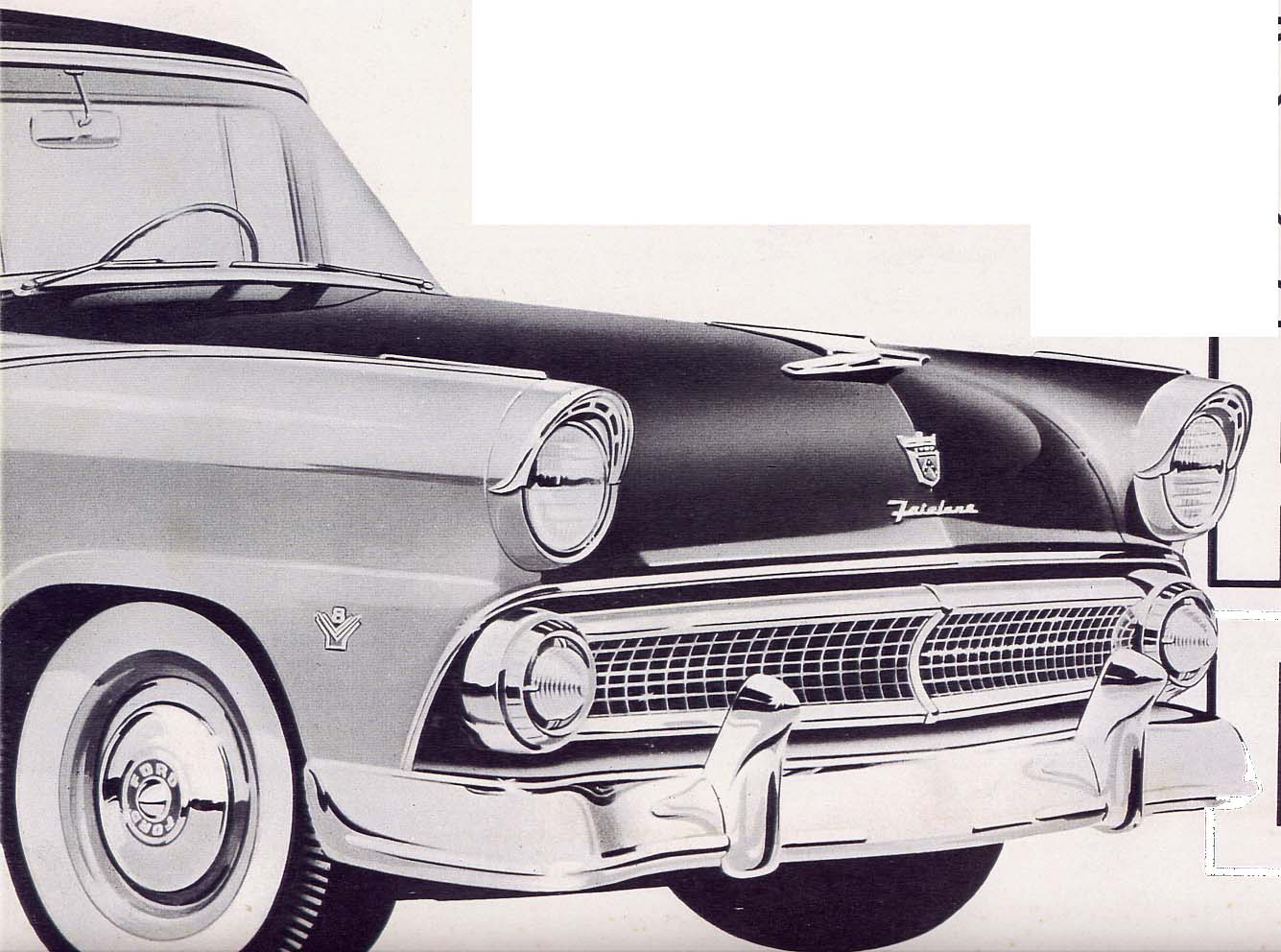
 Absolutely everyone associated with Ford Canada was as happy as larks (not the Studebaker variety to come) with the great success with the company’s 1954 Golden Jubilee. As the celebrations wound down, the nation’s oldest automaker prepared to usher in the second half of the century with the 1955 product line. 

The 1955 Ford lineup was sharp looking. 
Cars rode on a 115-inch wheelbase.
Negotiations between labour and management had not been going well for some time but both sides agreed not to upset the festivities. The last of the 1954 models rolled out the doors on October 7.  


On October 10, 1954, the talks stalled out. The sticking point was a 30-cent an hour pay rise and retro pay of 35 cents an hour to the end of the last contract. With no new offers forthcoming, 5,200 workers in Windsor, Ontario laid down their tools and headed for the picket lines. Even employees at the power plant struck. Office workers were instructed to report to work at temporary outside quarters as the administration buildings grew cold from lack of heat. 


Visit my old car website:  www.theoilspoteh.ca

The strike spread to Oakville on October 15 when 1,500 union brethren laid down their tools in sympathy. The company responded by moving its national headquarters permanently to Toronto on the 21st. The strike deepened when the 125 employees at the Etobicoke-based national parts depot joined in. Christmas came and went. On December 29 management announced it was prepared to consider a province-wide agreement for all 8,603 union employees but talks were recessed until January 3. Negotiations were tough and the 110-day strike was settled on January 27, 1955. Employees could get back to work and consumers could have their Fords. Manufacture began in early February. 


The 1955 Ford Mainline was the second least expensive
 model in the family. It cost $1,908.
The 1955 Ford Town Sedans were highly popular with consumers.
The four-door version (shown) cost $2,139 and the two-door $2,091.


The 968 dealers throughout the Dominion were absolutely frantic. The new Fords were to be unveiled to the public on November 10 and the Monarch lines on the 22nd. With a strike in progress and no 1955 models built it was hard to work up any enthusiasm for orders. A handful of models, not built in Oakville, were imported from the US so potential consumers would have something to see. Those cars included the four-door, three-seat Country Squire and Country Station Wagons, the Thunderbird and the Fairlane Crown Victoria with the transparent top. 

Visit my old car website:  www.theoilspoteh.ca

British Fords arrived at the port of Montreal for shipment to dealers. Zephyr four-door sedans and convertibles were prepped for public scrutiny along with Zodiac sedans and Consul ragtops. 

The Sunliner  (above) cost $2,451 in 1955. The imported  Ford
Zephyr convertible was evemmore expensive with its
$2,505 price tag.
When the new domestically built Fords did arrive at dealerships they were beautiful and well worth waiting for. Showroom floors glittered with six Fairlane models, two Customlines, a pair of Mainline models, a quartet of station wagons and the sensational Corvette-eating two-seat Thunderbird. 


The modest Mainline series consisted of a business coupe, a two- and four-door sedan. Sober and unadorned transportation they might be but advertising was able to truthfully bill them as “smartly practical new body styles” and “comfort you might expect only in cars costing hundreds more.”  Much was made of the fact that the doors were nearly a yard (ancient Canadian units of measure) wide and stayed open with a two-stage door check. 

The 1955 Ford Crown Victoria with the transparent top
weighed in at 3,388 pounds and cost $2,730.

The glamour queens in the Ford line belonged to the Fairlane family. There were a half dozen of the beauties to choose among. Catching up to independents Nash and Studebaker, Ford finally fielded a true hardtop model. The two-door Victoria was “enhanced by the new wrap-around windshield” and “quarter windows roll down out of sight leaving no centre posts and providing a wonderful feeling of openness!”

Visit my old car website:  www.theoilspoteh.ca
The Customline series was limited to a two- and four-door sedan with price tags of $1,957 and $2,006 respectively. Like the Mainline, it had black rubber flooring but the Customline received two sun visors, a half-circle horn ring and twin horns, foam in the seats, arm rests front and rear, an ash tray for back seat passengers, a cigarette lighter, a stem-wind clock, assist straps on the Tudor, coat hooks brightwork around the windows and exterior mouldings.


Crown Victoria interiors were replete with a centre arm rest.
The Crown Victoria with its massive “crown of chrome” at the B pillar could be had with the transparent “skylighted top.” Despite the glitzy centre post, advertising bragged that the Crown Victoria was “the style-setter of the hardtops.”  Less exotic Fairlanes included the lovely Sunliner convertible, the luxurious four-door Town Sedan and its equally posh stable mate, the two-door Club Sedan. 

Fairlane cabins were appointed with carpeting throughout. Upholstery was Nylon and Vinahyde or two-tone Vinahide over foam rubber cushioned seating and the steering wheel and steering column were colour blended to match the sumptuous surroundings. A unique space-age feature was the Astra-Dial speedometer with its clear plastic bubble top.

The eight-passenger Ford Country Squire
was imported from the US. Its hefty
$2,869 price tag was surpassed only by that of
the new Thunderbird.
Then there were the station wagons. The simple Ranch Wagon was a steal at $2,239 though customers looking strictly at the bottom line would opt for the Nash and Hudson Rambler two-door wagons, the least expensive on the domestic market at $2,127. Ford’s Custom Ranch Wagon could be ordered with two-tone finish, brightwork trim and “extra-colourful interiors.”  The third seat in the Country Sedan offered “room for eight or freight.”  The swanky Country Squire not only carried eight passengers, it stood apart as “ a station wagon of high distinction” with its Mahogany-grain-finished panels framed by a lighter coloured, wood-grained glass fibre mouldings gracing its sides. 


Finally there was the slippery Thunderbird, billed as the “brilliant personal car.”  The sleek and elegant two-seat sports car was as breathtaking as its $3,655 price tag. 

No matter which of the fifteen Fords one bought, there was but one mill-the ultra modern Y-block V-8. The 272-cid monster was mated to a higher torque, three-speed standard transmission. The manual tranny could be ordered with Overdrive or one could opt for Fordomatic, the shiftless transmission that featured an illuminated Safety-Sequence Selector in the P-R-N-D-L pattern.

Ford offered “Canada’s most modern Power Assists” as optional equipment. Power Lift windows, Swift Sure Power Brakes, Master-Guide Power Steering and the Four-Way Power Seat. Other add-ons were dual exhaust (standard on wagons and Fairlanes), white sidewall tires, a positive-action windshield wiper unit, a heater, the Full Circle Radio, rear fender shields and full wheel covers. 

Despite the lengthy strike, workers in Oakville pumped out 55,262 Ford passenger cars for the 1955 model year. The company announced it would spend $8.6 million to build new headquarters in Toronto. 

Visit my website:  www.theoilspoteh.ca
Copywrite 2004 James C. Mays